
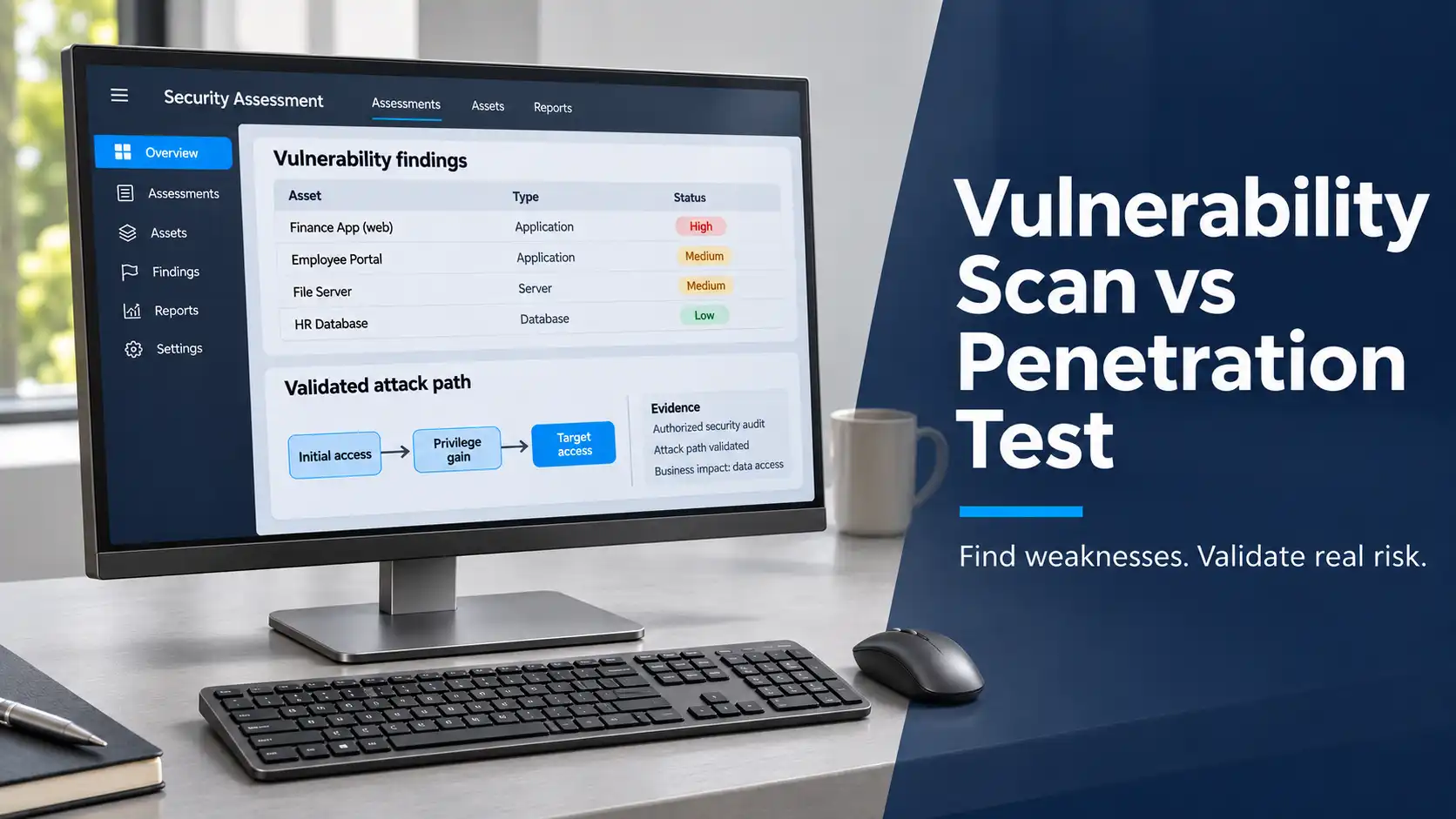

Ready to transform your IT experience? Reach out to our experts to discuss how our tailored solutions can meet your business needs and keep your technology running smoothly.
How Much Does a Penetration Test Cost? (2026 Pricing Guide)
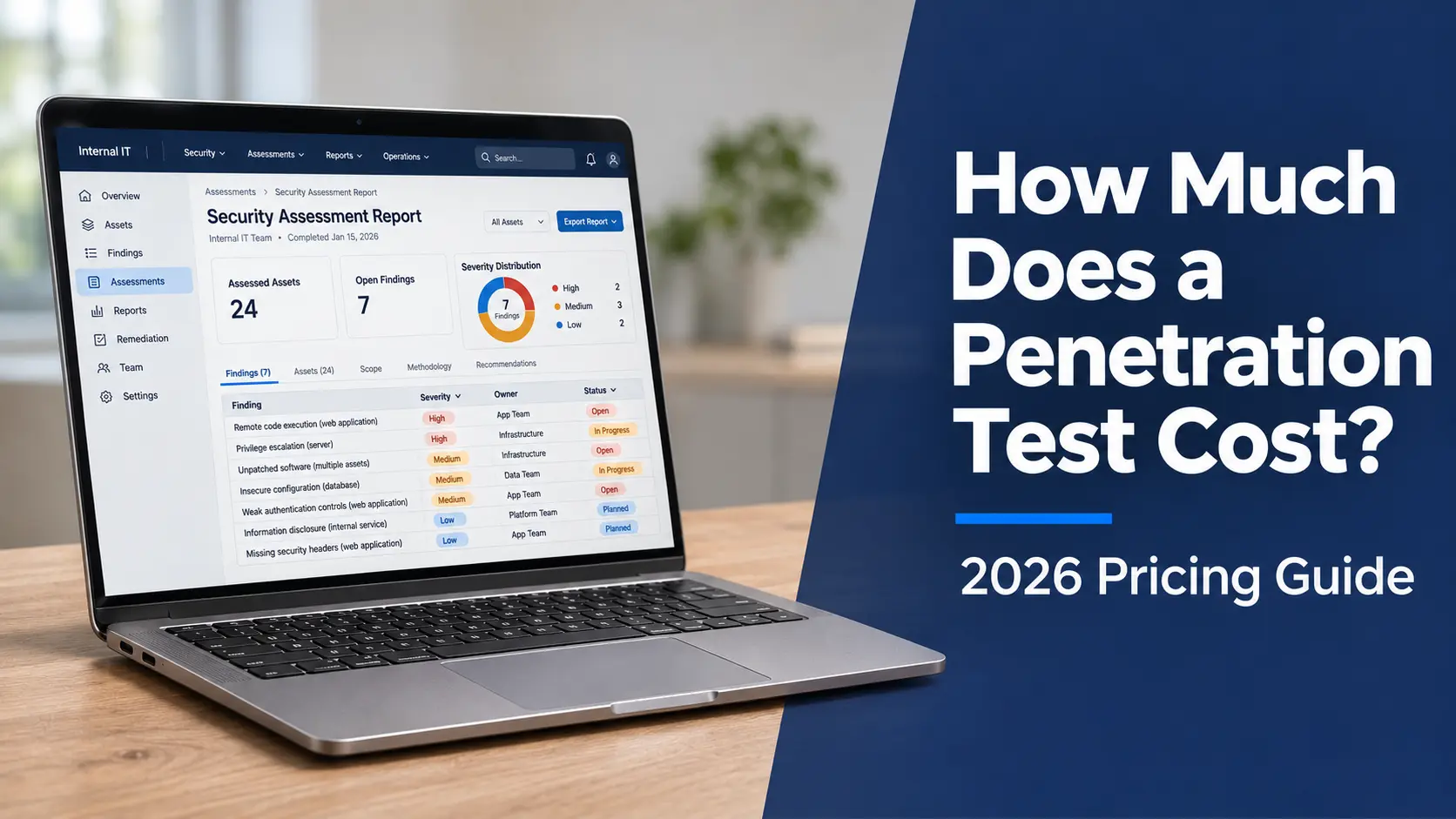
How much does a penetration test cost in 2026? Most small and midsize businesses pay $5,000 to $30,000. A small external test can start near $4,000. A combined internal and external test for a 10 to 250 person company usually runs $10,000 to $25,000. Your price depends on how many systems are in scope, how deep the testers go, and what your auditor or insurer needs to see.
Penetration test pricing can still look random. Two firms can quote the same network thousands of dollars apart, and neither explains the gap. This guide covers what each test costs, how pricing models work, how to prepare for a pen test audit, and what you get at the end. AllSafe IT has supported Southern California businesses for 20+ years, and our Managed IT & security team is often the group that fixes what testers find.
How Much Does a Penetration Test Cost in 2026?
Most quotes rest on one formula: tester days multiplied by a day rate. Experienced US testers bill about $1,600 to $2,800 per day. A five-day test at roughly $2,000 a day lands near $10,000, before retests or extra reporting.
Here is what each common test type costs in the US market this year.
| Test type | Typical 2026 cost | What sets the price |
|---|---|---|
| External network test | $4,000 to $20,000 | Number of public IP addresses and exposed services |
| Internal network test | $7,000 to $35,000 | Number of devices, Active Directory size, number of offices |
| Web application test | $5,000 to $30,000 | User roles, logins, payment and data integrations |
| API test | $5,000 to $20,000 | Number of endpoints and login methods |
| Cloud and Microsoft 365 test | $8,000 to $40,000 | Accounts, services, and tenant settings in scope |
| Wireless test | $5,000 to $15,000 | Number of sites and access points |
| Social engineering and phishing test | $3,000 to $15,000 | Number of users and type of campaign |
| Red team exercise | $20,000 to $150,000+ | Length of the exercise and its goals |
These are planning ranges, not quotes. Your scope sets the final number.
What a 10 to 250 Person Business Typically Pays
Picture a 60-person firm with one office, a firewall, a VPN, Microsoft 365, and a file server. That company does not need a red team or a mobile app test. It needs an external test and an internal test, and the price for that pair follows company size closely.
| Company size | Typical setup | Annual internal + external test |
|---|---|---|
| Under 50 employees | One office, under 20 public IPs | $8,000 to $15,000 |
| 50 to 150 employees | One or two offices, a few servers | $12,000 to $22,000 |
| 150 to 250 employees | Several offices, cloud workloads | $18,000 to $30,000 |
Add a web application test only if you run a client portal or custom app. Add cloud testing if most of your data lives in Microsoft 365, Azure, or AWS.
What You Get for Under $5,000
Most offers under $5,000 are automated scans with a short report. That has value, but it is a different product. A real test at that price covers a narrow scope: a handful of public IP addresses or one simple website, with two or three days of manual work. Free scanning tools exist too. They find known issues and stop there. No one tries to break in.
The test type you choose sets the floor for your budget, so that is the next decision.
Cost of a Penetration Test by Test Type
Each test answers a different question about your business. Pick the questions you need answered, and skip the rest.
External Network Penetration Test Cost
An external test asks: can someone on the internet get in? Testers probe your firewall, VPN, remote access portals, email systems, and anything else facing the web. Pricing follows your count of public IP addresses. An office with under 20 public IPs often pays $4,000 to $6,000. A footprint of about 100 IPs moves closer to $10,000 to $12,000.
Internal Network Penetration Test Cost
This test starts from inside, as if an attacker already controls one laptop. Testers try to reach file servers, steal passwords, gain admin rights, and move between systems. Active Directory is usually the main target. Cost rises with the number of devices and offices. A company with sites in both Los Angeles and Orange County pays more because each site needs a visit or a small testing device shipped to it.
Web Application and API Penetration Test Cost
Client portals, online intake forms, booking systems, and custom business apps fall here. Testers check logins, user roles, and how the app handles data. A simple site with one login can cost about $5,000. A portal with payments, many user roles, and connected APIs can pass $25,000.
Cloud and Microsoft 365 Penetration Test Cost
Most small business data now sits in Microsoft 365. A cloud test checks admin roles, conditional access, external sharing, legacy sign-in methods, and any Azure or AWS workloads. In our experience, tenant settings are where Southern California businesses carry the most hidden risk. For a Microsoft 365 shop, this test often finds more real problems per dollar than a web app test.
Wireless Penetration Test Cost
Wireless tests are priced per site. Testers look for weak encryption, rogue access points, and guest networks that can reach company systems. That last one is common in shared office buildings, where guest Wi-Fi was set up quickly and never checked again.
Social Engineering and Phishing Test Cost
These tests target people, not systems. Expect fake phishing emails, phone calls posing as IT support, and sometimes an attempt to walk into the office. Check what you already pay for first. Many security awareness programs include monthly phishing tests, so there is no reason to buy the same thing twice.
AI Tool and Copilot Security Testing Cost
AI testing is new and usually runs $10,000 to $30,000 for a chatbot or connected AI app. Most small businesses don’t need that yet. Microsoft 365 Copilot can only reach data the user already has permission to see. The real risk is old sharing links and broad permissions that Copilot makes easy to find. Fix permissions first. That costs far less than an AI-specific test.
Do You Need a Red Team?
Usually not. A red team runs a weeks-long attack to test whether your monitoring and response team catches it. That makes sense after basic findings are fixed and a 24/7 security operations center (SOC) is in place. Most 10 to 250 person businesses get more value from a solid internal and external test each year.
Once you know which tests you need, the next question is why quotes for them still differ so much.
What Drives Penetration Testing Cost
Why can two quotes for the same network differ by $8,000? Usually because they are not quoting the same work. These eight factors decide the number.
- Count your assets in scope. Public IPs, internal devices, apps, user roles, and offices. More assets means more tester days.
- Choose the testing approach. Black box gives testers no information. White box gives them everything. Gray box sits in the middle and is usually the best value for small businesses.
- Check tester experience. Senior testers with certifications such as OSCP, GPEN, or CREST cost more per day. They also find what scanners miss.
- Set the test depth. Authenticated testing logs in as a real user. It takes longer and finds more than testing from the outside only.
- Decide onsite or remote. Internal and wireless tests across several offices add travel time or shipped testing devices. Multi-site companies across the LA basin and Orange County should ask how each site will be covered.
- Add compliance reporting. Reports mapped to PCI DSS, SOC 2, or HIPAA take extra time to write.
- Confirm retest terms. Some firms include one retest. Others charge $2,000 to $4,000 for it.
- Book early. Last-minute tests before an audit deadline often carry a rush premium.
Scope explains most of the gap. The pricing model explains the rest.
Penetration Test Pricing Models Explained
Penetration test pricing follows six main models. The model can change your final bill as much as the scope does, so know which one you are buying.
| Pricing model | How it works | Best for | Watch for |
|---|---|---|---|
| Fixed price | One price for a defined scope | Most small businesses | Change orders if scope grows |
| Per asset | Priced per IP, app, or endpoint | Scaling tests up or down | Unclear asset counts |
| Day rate (time and materials) | You pay for tester days used | Narrow or advisory work | Days that creep up |
| Credits or retainer | Prepay for several tests a year | Firms that test often | Credits that expire |
| Continuous testing subscription | Annual fee for ongoing testing | Fast-changing apps | Higher sticker price |
| Bundled with managed security | Testing included in a wider service | Firms with an MSP | Independence (see below) |
How to Calculate a Pen Test Quote
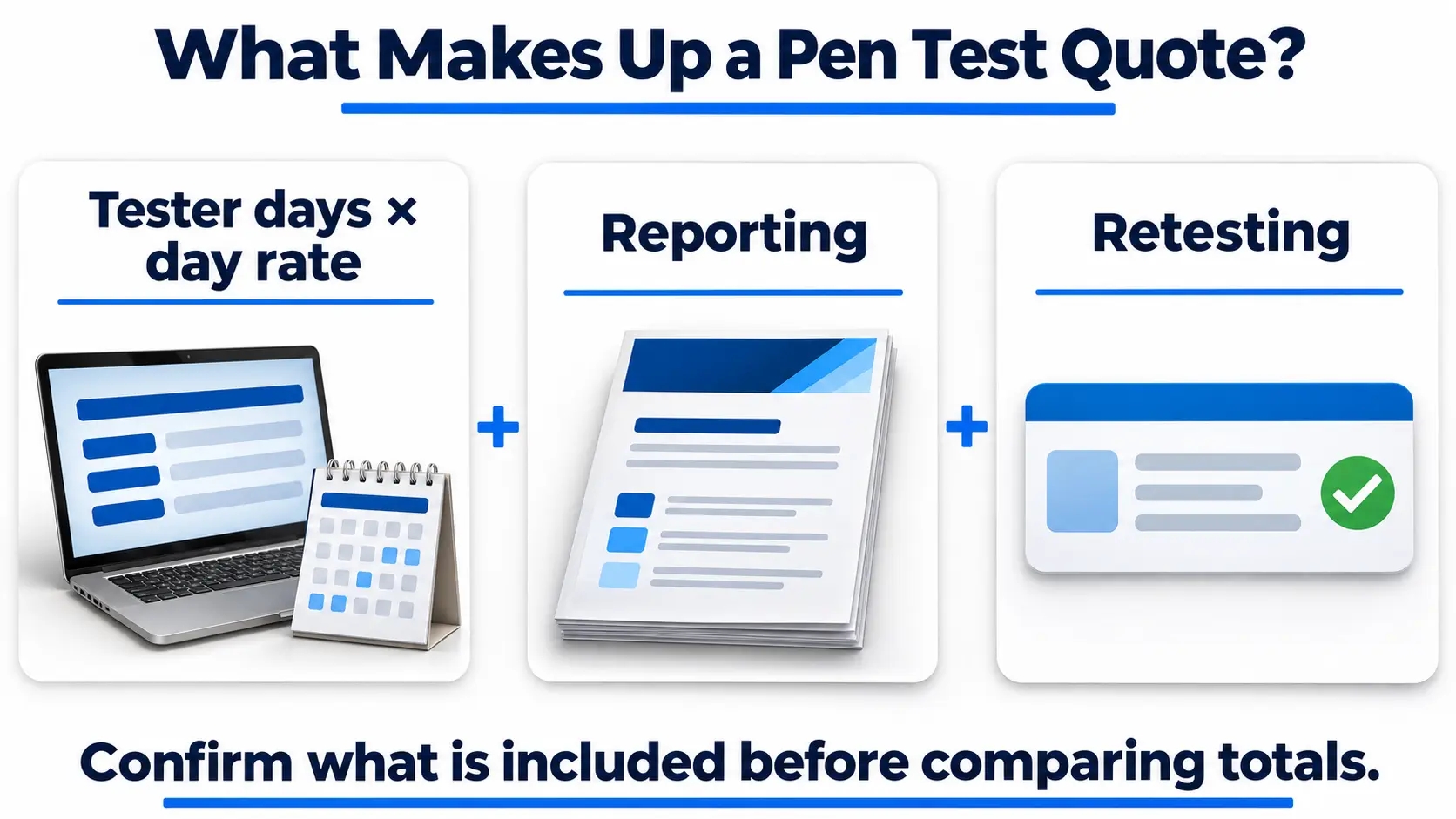
Start with tester days. Multiply by the day rate. Then add reporting time and any retest fee.
A typical small business example looks like this. Five tester days at $2,000 equals $10,000. Add one day for a compliance-ready report, and one retest at $2,500. The real total is about $14,500, not the $10,000 on page one.
Look for three common gotchas in any quote:
- Tester days that grow after the work starts
- Retest fees buried in the terms
- Scoping calls or report changes billed as extras
A cheap quote is often a scan priced as a test. Knowing the difference protects your budget.
Penetration Test vs Vulnerability Scan: Why the Price Gap Exists
Picture two reports on your desk. One lists 200 possible issues pulled by software in an hour. The other shows how a tester used three of those issues to reach your accounting server. The first is a vulnerability scan. The second is a penetration test, and it costs ten times more for a reason.
| Vulnerability scan | Penetration test | |
|---|---|---|
| Method | Automated software | Manual testing by a person, supported by tools |
| What it shows | Possible weaknesses | What an attacker can actually do |
| Frequency | Weekly to monthly | Once a year and after major changes |
| Output | Long list, many false positives | Ranked findings with proof |
| Typical cost | Low, often part of managed IT | $4,000 to $35,000+ per test |
A scan tells you what’s wrong. A pen test shows what an attacker could do with it. Most businesses need both.
How to Spot a Scan Sold as a Pen Test
Watch for these signs in a proposal:
- A 24 to 48 hour turnaround on a large scope
- No named testers and no count of tester days
- No authenticated testing
- A report that is raw scanner output with a cover page
- No proof of exploitation, such as screenshots of access gained
- No retest offered
If a quote checks three or more of these boxes, you are buying a scan. That may still be fine, as long as no rule says you need a real test.
Which Rules Require a Penetration Test?
Most small businesses buy a pen test because someone asked for one: an auditor, a client, an insurer, or a contract. Here is who requires it, and how often.
| Rule | Who it applies to | Pen test requirement | Status in 2026 |
|---|---|---|---|
| PCI DSS 4.0.1, Requirement 11.4 | Businesses that store, process, or transmit card data | Internal and external tests every 12 months and after significant changes | In force |
| FTC Safeguards Rule | CPA and tax firms, auto dealers, mortgage brokers, other non-bank financial firms | Annual pen test and vulnerability assessments every 6 months, unless continuous monitoring is in place | In force. Firms with customer data on fewer than 5,000 consumers are exempt from this part |
| HIPAA Security Rule update | Medical practices, clinics, and their business associates | Pen test every 12 months (proposed) | Proposed only. Final rule now projected for July 2027 |
| CMMC | Defense contractors and suppliers | Required at Level 3 only | Levels 1 and 2 have no explicit pen test requirement |
| California CPPA cybersecurity audits | Businesses under the CCPA that meet the rule’s revenue and data-volume thresholds | Pen testing is a listed part of the annual audit | Rules effective January 1, 2026. First certifications due April 1, 2028 to April 1, 2030, based on revenue |
| SOC 2 | Service companies that handle client data | Not mandated, but auditors and customers expect it | Market expectation |
Two points get missed often. First, the HIPAA change is still a proposal, so treat it as a planning signal, not a current mandate. Second, CMMC Level 2 does not require a pen test, even though many Orange County defense suppliers are told it does. Our guide to CMMC Level 1 requirements covers where each level starts.
If you aren’t sure which rules touch your business, IT audit and compliance support can map them before you pay for testing.
Does Cyber Insurance Require a Penetration Test?
Some carriers ask about penetration testing on applications and renewals. It is not a universal rule. Read the questionnaire wording closely, because “annual third-party penetration test” and “regular vulnerability scanning” are different answers. Our post on cyber liability insurance covers what underwriters commonly ask.
Once you know a test is required, preparation decides how smoothly it goes.
How to Prepare for a Penetration Test Audit
To prepare for a penetration test audit, set a clear goal and scope, sign written authorization, and get your IT team ready before testing starts. Then book time to fix findings before the audit date. Most delays come from missing paperwork and unprepared systems, not from the test itself.
Use this checklist:
- Name the goal. Compliance evidence, an insurer request, or a true risk check. Each needs a different report.
- List every asset. Mark what is in scope and what is out of scope, in writing.
- Sign the authorization. Get a signed scope and rules of engagement. Testing without written permission can break the federal Computer Fraud and Abuse Act.
- Pick the approach. Choose black, gray, or white box, and create test user accounts if needed.
- Set testing windows. Agree on dates, hours, and an emergency contact on both sides.
- Tell your IT provider. Your security team needs to know when testing runs, so alerts get handled correctly.
- Verify a backup. Run and test a backup before testing starts.
- Freeze big changes. Hold off on major updates or migrations during the test.
- Book fix and retest time. Leave weeks, not days, between the report and your audit deadline.
What Your IT Provider Should Do Before Testing Starts
This is the step most guides skip. Your IT provider controls the tools the testers will run into. Before day one, they should decide with you whether security tools block testers or just alert on them. Each choice tests something different. They should also confirm backups, document admin accounts, and set an after-hours window for any risky checks.
A tester blocked on day one by a firewall rule no one mentioned wastes a billable day. A short call between your IT provider and the testing team avoids that.
What Evidence Auditors Expect
Auditors want proof the test happened and that you acted on it. Keep the signed scope, the methodology, the dated final report, your remediation records, and proof of the retest. PCI DSS asks you to keep test results and remediation records for at least 12 months. Other frameworks expect similar records.
All of that evidence points back to one document: the report.
What Is the End Result of a Penetration Test?
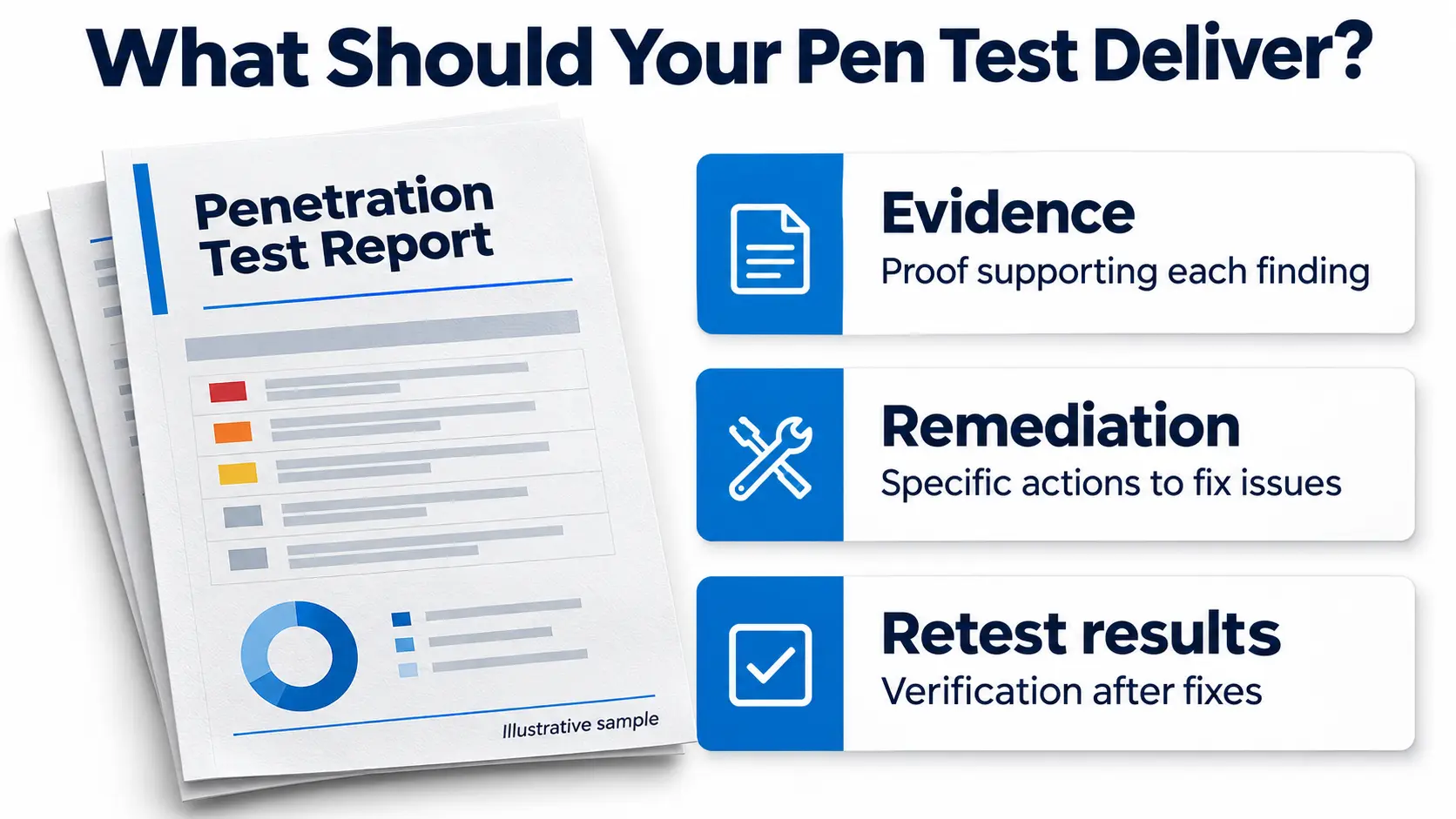
The end result of a penetration test is a written report. It shows what testers broke into, how they did it, what it means for your business, and how to fix each issue. A good report also includes a short summary for leadership and, on request, a letter you can share with clients or auditors.
A strong report includes these parts:
- Executive summary: the main risks in plain language, one or two pages
- Scope and methodology: what was tested, when, and how
- Attack narrative: how testers chained small issues into real access
- Findings with severity ratings: usually scored with CVSS, from critical to low
- Proof of each finding: screenshots, commands, and data accessed
- Business impact: what each finding could cost in downtime, data, or trust
- Remediation steps: specific fixes, not general advice
- Retest results: proof that fixed issues stay fixed
- Attestation letter: a short summary you can share instead of the full report
One honest caveat. A pen test is a snapshot. It shows what testers could do on the days they tested. A clean report does not mean you are safe next quarter.
What to Do After You Get the Report
The report is the start of the work, not the end. Here is how to use it.
- Fix critical and high findings first. Set target dates by severity, such as days for critical issues and weeks for medium ones.
- Retest the fixes. Ask the testing firm to confirm each fix worked.
- Update your risk register. Record what was found, what was fixed, and what you accepted.
- Share the right document. Send the attestation letter to clients and insurers. Keep the full report internal.
- Feed findings into next year’s scope. Repeat findings point to a process problem, not a one-time mistake.
Reports only help if the firm behind them did good work, which makes choosing the firm the next step.
How to Compare Penetration Testing Quotes
Price is the last thing to compare. Send every provider the same written scope, then ask these questions:
- How many tester days does this quote include?
- Who are the testers, and what certifications do they hold?
- Will you test as a logged-in user, or from the outside only?
- Which methodology do you follow? Look for NIST SP 800-115, the OWASP Testing Guide, or PTES.
- Can we see a sample report with client details removed?
- Is a retest included, and within what time window?
- How do you store and delete our data after the test?
Compare answers side by side. A higher quote with named senior testers and an included retest often costs less in the end.
Should Your IT Provider Test Its Own Work?
Our position is simple: the team that built and runs your network should not be the only team grading it. A provider testing its own setup has a blind spot, even with good intentions. California’s new cybersecurity audit rules make the same point, since they require auditors to be qualified, objective, and independent.
That doesn’t mean your MSP stays out of it. Your provider should help scope the test, prepare systems, and fix findings. The testing itself should come from a separate team with no stake in the result.
Once you pick a provider, the budget question becomes how often to test.
How Often Should You Budget for a Penetration Test?
Plan for one penetration test a year, plus a test after any significant change. A new office, a server replacement, a cloud migration, or a merger all count. Vulnerability scans should run weekly to monthly between tests.
Here is a sample annual budget for a 50-person firm with one office:
| Line item | Typical annual cost |
|---|---|
| Annual internal + external test | $12,000 to $18,000 |
| One change-triggered test (new office or migration) | $5,000 to $8,000 |
| Retest | $0 to $3,000, depending on terms |
| Vulnerability scanning | Often included in managed IT services |
| Total | About $17,000 to $29,000 |
Is the Cost of a Penetration Test Worth It?
Compare the cost of a penetration test against what it helps you avoid: a ransomware recovery, days of downtime, a failed audit, or a client contract you can’t renew. For most regulated businesses, the test is not optional anyway. The better question is whether you are paying for a real test or a scan with a nicer cover page.
You don’t need to cut corners to spend less. You need to cut waste.
How to Lower Penetration Testing Cost Without Cutting Corners
These steps shrink the bill without weakening the test:
- Fix scanner findings first. Don’t pay a tester $2,000 a day to report missing patches.
- Run a gap assessment first. Find the obvious problems before the formal test.
- Test internal and external together. One engagement costs less than two.
- Choose gray box testing. Sharing basic network details saves tester days.
- Phase the scope by risk. Test the systems holding client data this year, and the rest next year.
- Book early. Avoid rush pricing before audit deadlines.
- Get the retest included. Negotiate it before you sign.
A tighter scope and a prepared network give you more findings per dollar. Common questions follow.
Penetration Test Cost FAQ
How much does a standard penetration test cost?
A standard penetration test costs about $10,000 to $35,000 in the US. For a small or midsize business, a combined internal and external test usually runs $10,000 to $25,000. A single external test of a few public IP addresses can start near $4,000. Larger scopes, web portals, and compliance reporting push the price up.
How long does a penetration test take?
Most small business tests take one to two weeks of active testing. A combined internal and external test for a midsize company often needs 5 to 10 business days. Add a week or two for scoping before the test and for the written report after. Rush timelines usually cost more.
Is it illegal to run a penetration test?
A penetration test is legal when the system owner gives written permission first. Testing systems without authorization can violate the federal Computer Fraud and Abuse Act and state computer crime laws, including California’s. That is why every real engagement starts with a signed scope and rules of engagement.
Can I get a penetration test for under $5,000?
Yes, for a narrow scope. A few days of manual testing on a handful of public IP addresses or one simple website can fit under $5,000. Many offers at that price are automated scans with a short report. Ask how many tester days are included and whether anyone tries to exploit what the scan finds.
How much does a penetration test cost in California?
California prices track the national range: about $5,000 to $30,000 for most small and midsize businesses. Costs rise when internal or wireless testing covers several offices, such as sites in both Los Angeles and Orange County. Businesses covered by California’s new cybersecurity audit rules may also pay more for reporting an auditor can use.
Does cyber insurance require a penetration test?
Some cyber insurance carriers ask about penetration testing on applications and renewals, but it is not a universal requirement. Read your questionnaire wording closely. If it asks for an annual third-party penetration test, a vulnerability scan alone will not satisfy that answer. Ask your broker before renewal.
Why does penetration test pricing vary so much between providers?
Penetration test pricing varies because providers quote different work. One firm prices five days of manual testing by a senior tester. Another prices an automated scan with a light review. Scope wording, tester experience, logged-in testing, and retest terms all change the number. Compare tester days and deliverables, not the total alone.
The cost of a penetration test makes sense once you know what you are buying. Start this week with two lists: the systems your business runs on, and the rule, client, or insurer asking for the test. Then get two quotes on the same written scope and compare tester days, not totals. If you want help scoping it, our penetration testing services team can walk through your setup with you.