


Ready to transform your IT experience? Reach out to our experts to discuss how our tailored solutions can meet your business needs and keep your technology running smoothly.
AllSafe IT Founder Bones Ijeoma Featured on EO Wonder Podcast: AI Agents, Business Growth, and the Bolt-On Trap
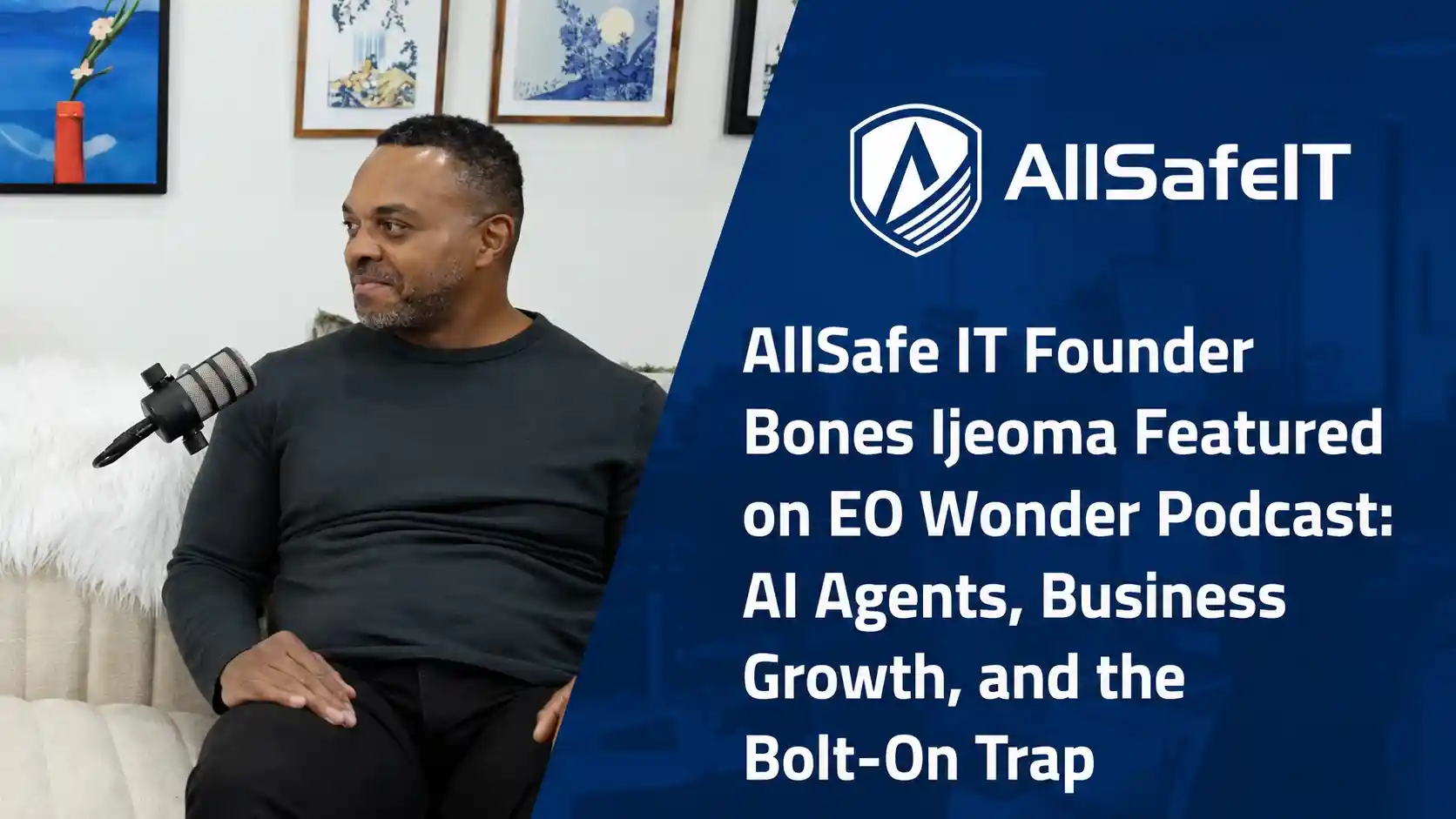
Bones Ijeoma, founder of AllSafe IT and AllSafe Intelligence, recently appeared on the EO Wonder Podcast to discuss one of the most misunderstood topics in business technology: how to actually get results from AI.
The episode, titled “How AI Agents Can Help Your Business with Growth,” was hosted by Kalika Yap of the Entrepreneurs’ Organization (EO). The conversation runs just under 50 minutes and covers practical AI implementation, the difference between chat tools and agent-based systems, and why cybersecurity belongs in every AI conversation from day one.
Watch the full episode on YouTube: How AI Agents Can Help Your Business with Growth
Listen on Spotify: EO Wonder Podcast — Bones Ijeoma Episode
The Problem Most Businesses Are Hitting
Bones brought a clear diagnosis to the conversation. Most small and mid-sized businesses that feel stuck with AI aren’t suffering from a technology problem. They’re suffering from a process problem.
They’ve layered AI on top of existing workflows without changing the workflows themselves. Bones calls this the bolt-on trap. The tools speed things up, but the underlying process stays the same, and the ceiling on what you can accomplish stays the same with it.
“If AI is just helping you do your current process better, that’s what we call bolt-on. What we want is for AI to allow you to do things you couldn’t do before.” - Bones Ijeoma
A quick example makes the gap concrete. A bolt-on approach to invoice processing has AI convert a PDF into a spreadsheet. A person still imports that spreadsheet into the accounting system. An agent-based approach gives AI its own mailbox, lets it read every incoming invoice, parse the data, and enter it directly into the platform, with a human doing a final review before submission. No manual steps in between.
The difference isn’t speed. It’s what you’re able to do at all.
The AllSafe Intelligence Three-Engine Framework
Bones introduced the framework his AI consulting firm uses to help businesses identify where agent-based AI will create the most impact. AllSafe Intelligence uses this framework to map AI investment to the three core drivers every business depends on. The real gains come from improving all three, not just the one that’s most visibly broken.
- Customer Acquisition is how the business generates new revenue. AI agents can research target accounts, build personalized outreach, and prepare proposals, moving from prospect identification all the way to a calendar booking without requiring a human to hand off between steps.
- Operations is how the business delivers its services once customers are engaged. Reconciling purchase orders (POs), tracking vendor W9s, generating financial reports, and routing information between departments; :these are high-friction, error-prone tasks that are well-suited to full agent automation. Bones noted that anywhere a business has more than ten people, interdepartmental handoffs are almost always a source of delays.
- Customer Experience is how the business retains customers and keeps them engaged. Voice agents can handle HR policy questions around the clock. AI systems can read inbound support emails and respond with specific, relevant answers within seconds. The speed and accuracy of AI-driven responses has started to shift customer expectations broadly, not just in large enterprises.
Most business owners focus on whichever engine is loudest and most broken. The real benefit comes when all three engines run on AI systems that communicate with each other.
Agents vs. Chat: Why the Distinction Matters
Bones drew a clear line between the two main modes of working with AI. It’s a distinction that changes how much you can actually delegate.
Chat-based AI is task-driven. You give it an instruction, it responds, you return with the next instruction. You’re involved at every step. That’s useful, but it still puts you in the middle of every process.
Agent-based AI is outcome-driven. You define the result you want. The agent coordinates the steps, pulling in specialized sub-agents along the way, one for research, one for drafting, one for scheduling, and delivers the finished output. You’re the director. You set the destination. The agents find the route.
That shift from task-driven to outcome-driven thinking is where businesses start to see results they couldn’t achieve before.
What This Looks Like in Operations
Bones walked through specific use cases his team has implemented with clients. His firm uses agents to process POs, build financial projections, and check whether new vendor invoices have an associated W9 on file. If a W9 is missing, the system drafts and sends a request automatically, then logs the action in the project management platform so the team can see what the AI did and when.
He also pointed to interdepartmental communication as a consistent source of friction. Most businesses run finance, sales, and operations on different platforms: maybe QuickBooks for accounting, HubSpot for sales, and Monday.com for projects. Those systems don’t naturally talk to each other. When they don’t, someone becomes the manual go-between. AI agents can serve as that connective layer, routing data between systems without requiring a person to do the handoff.
What This Looks Like in Customer Experience
Bones shared a personal example that captures what the customer experience shift actually feels like. He sent a support email to a vendor and received a specific, relevant response in 45 seconds. No waiting. No scripted reply. The AI read the email, understood the issue, and answered it.
He described it as one of the best support interactions he’d had, and he knew the entire time that he was talking to an AI system. Speed and relevance mattered more than the source.
That’s where customer expectations are heading. Businesses that can provide fast, accurate responses from small teams will hold an advantage. The businesses that still take 24 hours to reply to a basic inquiry are already at a disadvantage, regardless of how good their service is otherwise.
Security and Guardrails: Not Optional
AI agents have access to your data, your email, your calendars, and in some cases your internal systems. That access is what makes them useful. It’s also what makes proper setup non-negotiable.
Bones raised two specific concerns. The first is prompt injection, where a bad actor embeds instructions inside content the AI is designed to process, attempting to redirect what the agent does. The second is the rise of AI-orchestrated attacks. He noted that earlier this year, a cyberattack was identified that was largely orchestrated by AI, a meaningful shift in the threat environment for every business.
His advice was direct. Hire a professional to set these systems up correctly. Don’t treat AI consulting and cybersecurity as separate conversations. The security posture has to be built alongside the automation strategy, not added afterward.
This is exactly where AllSafe IT’s model is relevant. The firm provides managed IT services, cybersecurity, and AI consulting together, so the infrastructure, the security layer, and the AI implementation are planned as a single system rather than three separate projects that have to be reconciled later.
The Skills Shift Bones Sees Coming
Bones spent part of the conversation on a broader question: what skills will matter going forward?
His read is that we’re moving out of the knowledge economy, where what you know is your primary value, and into a skills economy. AI can surface information rapidly. Knowing the information is no longer the edge. Knowing what to do with it, how to communicate with AI systems to get the best outputs, how to identify where automation fits, and how to see around the corner in your own industry, those are the skills that will compound in value.
He also introduced a technique he calls reverse prompting. Rather than always asking AI questions, you can prompt the AI to ask you questions. That dialogue often surfaces assumptions and gaps that a one-way query misses. Business owners can use an AI as a sounding board for strategy, a way to stress-test decisions, or a way to think through how AI will affect their specific market.
About Bones Ijeoma and AllSafe IT
Bones Ijeoma has 25 years of experience in technology, with prior work at Accenture, DreamWorks, UCLA Medical Center, and Marriott. He holds an MBA from the University of Southern California and a Computer Engineering degree from CSU Long Beach. He has guided more than 100 organizations through digital transformation.
He founded AllSafe IT in 2003 and AllSafe Intelligence as its AI consulting arm. AllSafe IT is a 7x CRN MSP 500 award winner, most recently recognized in the 2026 Pioneer 250 category, and holds SOC 2 certification. The firm serves small and mid-sized businesses across Los Angeles, Pasadena, and Orange County, with a local engineering team available for on-site support.
Ready to Move Past Bolt-On AI?
AllSafe Intelligence works with businesses in Southern California to map AI investment to real business outcomes across all three engines: acquisition, operations, and customer experience.
If you’re ready to move from experimentation to implementation, contact the AllSafe IT team to start the conversation.