


Ready to transform your IT experience? Reach out to our experts to discuss how our tailored solutions can meet your business needs and keep your technology running smoothly.
How Much Time Are People Spending Talking to Chatbots? [2025 Survey]
![How Much Time Are People Spending Talking to Chatbots? [2025 Survey]](/images/blog/time-spent-talking-to-chatbots-2025-survey/human-and-chatbot-interaction.avif)
A new survey reveals Americans are spending record amounts of time chatting with AI and growing numbers see chatbots as friends, confidants, and even wedding officiants. Dive into the surprising state-by-state trends.
AI chatbots have quietly woven themselves into the fabric of American life, with a number of states embracing these AI automation services far more enthusiastically than others.
Some are practically building second lives online, while others are treating AI as a passing distraction.
Beyond screen time, the survey hints at deeper questions about trust, secrets, and whether Americans see these bots as tools or companions.
Our survey of 3,012 respondents revealed some interesting habits of our AI lifestyles:
Key findings
-
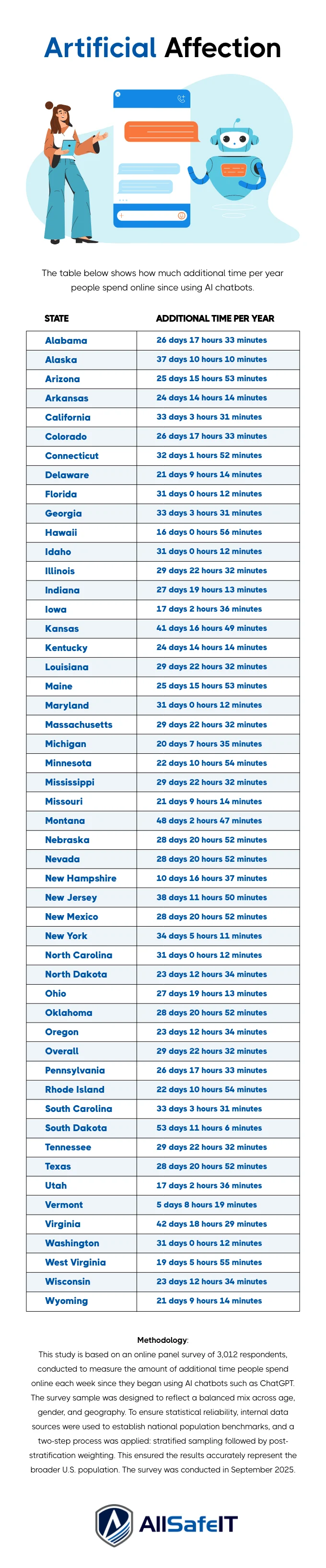
South Dakota tops the charts with 53 extra days spent chatting - nearly two months of digital companionship. That’s more time than the average American takes for vacation in a year. It suggests AI is less a novelty here and more a lifeline, filling long, rural stretches with conversation.
-
Montana, Virginia, and Kansas aren’t far behind, all topping 40 extra days. It’s telling that three of the top four are quieter, less urban states - chatbots may be standing in for social opportunities that aren’t as abundant offline.
-
Vermont barely registers with just five days. New Hampshire isn’t much higher at ten. In these smaller, tight-knit states, it looks like people still prefer face-to-face chats over algorithmic ones.
-
Is it friendship - or just an app? Our survey found 37% of Americans describe their chatbot relationship as closer to a friend than an app. That’s a hefty chunk - and it tracks closely with states spending the most time online.
-
Confessions and secrets - Roughly 42% would rather confess to a chatbot than a therapist or priest, and 32% admit to telling their bot things they would never tell family or partners. That’s striking when you compare it with states like New York (34 days) or California (33 days)—high-engagement areas where density, anonymity, and tech culture already encourage people to share more freely online.
By contrast, states with minimal use (Vermont, New Hampshire) may not yet be pushing into that intimate territory.
-
Quirks worth noting: 22% of Americans admit they would cancel plans to continue a good chatbot conversation. Pair that with Virginia’s 42 extra days, and you can almost picture double-booked calendars where dinner with friends loses out to digital banter.
-
Some stats are surreal: nearly a quarter of respondents would let a chatbot officiate a wedding.
From chatbot confessions to business imperatives: The critical link to AI uptime
The survey findings paint a vivid picture: AI chatbots are not just tools. For many Americans, they’re becoming confidantes, companions, and even trusted advisors.
This shift in perception—from a mere application to a near-friendship—carries profound implications, especially for businesses that increasingly rely on AI automation services.
When users are willing to cancel plans for a chatbot conversation or trust AI to officiate a wedding, it highlights a deep emotional and functional reliance.
For businesses, this is about the core of customer interaction, operational efficiency, and brand loyalty. If a chatbot is seen as a “friend,” what happens when that friend suddenly goes silent?
This growing dependence on AI, both personally and professionally, underlines a critical business imperative: AI system uptime is a foundational element of trust, service delivery, and competitive advantage.

Why AI system uptime matters more than most businesses realize
Businesses rely on AI tools more than ever. Chatbots handle customer inquiries. Automated systems process orders. AI assistants schedule meetings and manage workflows.
But what happens when these systems go down?
The hidden cost of AI downtime
We recently worked with a company in Orange County that built customer service around chatbots. Their AI tools handle 60% of initial customer inquiries. When their system crashed for three hours on a busy Tuesday, those interactions disappeared completely.
Customers hang up. Sales leads evaporate. The impact extends far beyond the immediate outage.
The sad thing is, this scenario happens more often than most realize.
Common IT issues like server failures, network connectivity problems, or routine maintenance can knock AI systems offline without warning.
For businesses that have integrated AI automation services into core operations, these interruptions translate directly to revenue loss.
Why AI infrastructure needs special attention
AI systems require a different approach than traditional IT support. These tools often integrate with multiple platforms, process sensitive data, and operate across time zones. A single point of failure can cascade through interconnected systems.
Smart companies treat AI infrastructure with the same seriousness they give their primary business applications. This means:
-
Redundant systems that provide backup coverage
-
Monitoring tools that catch problems before users notice
-
Response protocols that minimize disruption time
-
Regular health checks and maintenance schedules
The trust factor in AI relationships
Recent surveys show that 37% of users view their relationship with business chatbots as friendship-level connections.
When that “friend” suddenly stops responding, the trust break feels personal, not just technical.
This emotional connection makes AI uptime even more critical for customer retention and brand loyalty.
Building reliable AI systems
Assessment and planning
Southern California businesses implementing AI automation discover that uptime planning requires specialized expertise. Robotic process automation consulting helps companies assess their current systems and identify potential failure points.
It’s not enough to install the technology and hope it keeps working. You need proactive monitoring, regular system health checks, and backup protocols designed specifically for AI workloads.
Choosing the right support model
Companies serious about AI reliability work with providers who understand that managed IT services in Los Angeles must evolve beyond traditional server monitoring to include AI-specific reliability measures.
Some businesses opt for co-managed IT services that blend internal expertise with specialized AI support. This approach works particularly well for companies with technical teams who understand the business logic but need help with the infrastructure complexity that AI automation demands.
Key components of AI uptime strategy
Effective AI reliability planning includes:
-
Multi-layered backup systems that can take over seamlessly
-
Real-time monitoring that tracks AI performance metrics
-
Automated failover protocols that minimize manual intervention
-
Regular testing of backup and recovery procedures
-
Clear escalation paths for different types of failures
Getting started with AI uptime planning
The numbers paint a fascinating picture: across the board, Americans are starting to confide, trust, and even prioritize AI automation services over human interactions.
Whether that’s a sign of deeper loneliness or simply digital convenience depends on how you look at it - but one thing is clear: the line between tool and friend is getting thinner by the day.
The businesses that maintain reliable AI systems treat this infrastructure as business-critical from day one. They understand that AI downtime doesn’t just interrupt processes, but breaks customer relationships and damages competitive positioning.
Ready to ensure your AI tools stay online when your business depends on them?
AllSafe IT’s AI automation service team can assess your current setup and recommend reliability improvements that protect both your technology investment and customer relationships.