



Ready to transform your IT experience? Reach out to our experts to discuss how our tailored solutions can meet your business needs and keep your technology running smoothly.
Credential Stuffing: How It Threatens Small Businesses and How to Stop It
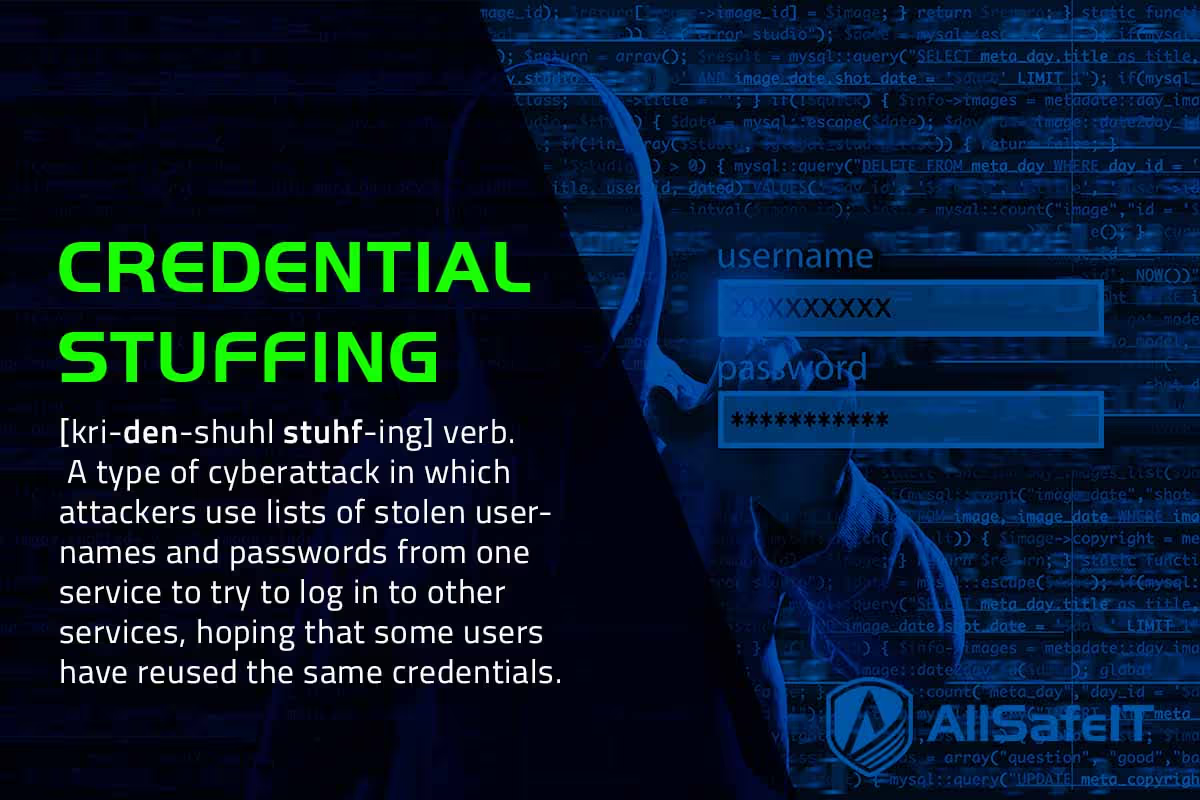
Learn what credential stuffing is, how cybercriminals use it to exploit your online accounts, and how you can protect yourself from this common form of cyberattack.
Credential stuffing is a cyberattack where criminals use stolen usernames and passwords from one data breach to break into accounts on another platform. For a small business, that usually means an employee’s reused password unlocking their Microsoft 365 or Google Workspace login. Once that happens, an attacker has a foothold inside the company, not just one account.
Credential stuffing attacks on small businesses rarely make headlines. They don’t need to. A single reused password is often all it takes.
How Credential Stuffing Threatens Small Businesses
Most articles about credential stuffing describe attackers reselling access to a Netflix or Spotify account. That framing misses what actually matters to a small business owner. The real risk sits inside your company’s own login systems: email, file storage, accounting software, and any application tied to a company account.
When an attacker gets into an employee’s Microsoft 365 login, they don’t just read email. They can set up forwarding rules to monitor invoices, reset passwords on connected apps, or send convincing messages from a real employee’s account to vendors and clients.
If your business needs a second set of eyes on this kind of exposure, our ongoing security monitoring for Pasadena businesses is built around catching this pattern before it spreads.
This is account takeover, not account resale. The distinction matters because the damage compounds. One compromised login can expose client data, financial records, and every other account that employee touches.
Credential Stuffing vs. Brute Force: What’s the Difference
Credential stuffing and brute force attacks get lumped together often, but they work differently. Brute force guesses passwords through trial and error, testing common patterns until something sticks. Credential stuffing skips the guessing entirely. It uses passwords that are already known to be real, stolen from a breach at some other company.
| Credential Stuffing | Brute Force | |
|---|---|---|
| Starting point | Real, stolen credentials | Guessed or common passwords |
| Success driver | Password reuse across sites | Weak, predictable passwords |
| Detection difficulty | Higher, looks like normal logins | Lower, repeated failed attempts stand out |
| Best single defense | Multi-factor authentication | Strong, unique passwords |
A strong password stops brute force. It does nothing against credential stuffing if that same password was exposed somewhere else. Learn more about how brute-force password attacks work and how they differ in practice.
Why This Is a Bigger Risk Than Most Businesses Realize
Here is what we see most often during new client security assessments: multi-factor authentication is turned on, but only for a handful of accounts. Usually the owner. Sometimes an office manager. Rarely everyone.
That partial coverage creates a false sense of security. Attackers running credential stuffing campaigns test accounts in bulk. They are not targeting your business specifically. They are running the same stolen password list against thousands of login pages, and yours is one of them.
The businesses that get hit hardest are usually the ones who assumed MFA was already handled. It was handled for three people out of thirty.
Understanding how MFA actually stops account takeover changes how you think about rolling it out. Coverage matters more than adoption.
Preventing Credential Stuffing at Your Business
Prevention here is not complicated. It is a matter of consistency, not sophistication. Three things matter more than anything else: unique passwords, a password manager, and MFA enforced across every account, not just the ones that seemed important.
Password reuse is the entire mechanism credential stuffing depends on. Remove that, and most stuffing attempts fail before they start.
A Quick Checklist for This Week
- Confirm MFA is enabled for every employee account, not just admins
- Roll out a password manager and require unique passwords per service
- Review login alerts for Microsoft 365 or Google Workspace and turn them on if they are off
- Check whether any shared logins exist across your team and eliminate them
- Schedule a short refresher on password hygiene, even a 15-minute one
Security awareness training helps here too. Most employees do not reuse passwords out of carelessness. They do it because remembering forty different passwords is genuinely hard. Security awareness training that addresses this directly, rather than lecturing about generic best practices, tends to stick better.
What a Credential Stuffing Breach Means Under California Law
A successful credential stuffing attack that exposes customer data can trigger notification obligations under California’s privacy laws, specifically the CCPA and its amendment, the CPRA.
What we tell clients is simple: the notification question depends entirely on what was exposed, not on how the attacker got in. A stuffed employee login that led to customer Social Security numbers or financial account details is a different conversation than one that only exposed internal scheduling data.
If your business handles customer personal information and you are unsure where you stand, that is worth a direct conversation with legal counsel and your IT provider together, not after a breach, before one.
Frequently Asked Questions
Is credential stuffing the same as a brute force attack?
No. Credential stuffing uses real, previously stolen usernames and passwords, while brute force guesses passwords through repeated trial and error. Credential stuffing succeeds because people reuse passwords across services, not because a password is weak.
How do I know if my business has been targeted by credential stuffing?
Watch for login alerts from unfamiliar devices or locations, sudden password reset requests you did not initiate, or unusual activity in Microsoft 365 or Google Workspace security logs. Many platforms will flag suspicious sign-in attempts automatically if alerts are turned on.
Does multi-factor authentication stop credential stuffing?
Mostly, yes, but only when it is enforced across every account. A stolen password becomes far less useful to an attacker if a second verification step is required. Partial MFA coverage, limited to a few accounts, leaves the rest of your business exposed.
What should a small business do to prevent credential stuffing?
Require unique passwords for every service, use a password manager to make that practical, and enforce multi-factor authentication for every employee account, not just administrators. These three steps address the mechanism credential stuffing relies on most directly.
Do California businesses have to report a credential stuffing breach?
It depends on what data was exposed. California’s privacy laws include notification requirements tied to specific categories of personal information. If customer data may have been accessed, a conversation with legal counsel is the right next step.
Can a password manager fully prevent credential stuffing?
A password manager reduces risk significantly by making unique passwords practical to maintain, but it is not a complete solution on its own. Pairing it with multi-factor authentication closes the gap that reused or stolen passwords leave open.
If you want a clear picture of where your business stands on password practices and account security, our team can walk through it with you directly.