Why infrastructure as a service matters for growing businesses
Managing physical infrastructure creates bottlenecks for growing businesses. Buying physical servers requires upfront capital expenditures. Operating your own data center demands specialized staff. Scaling on premises infrastructure takes months of planning and procurement.
Infrastructure as a service changes this model completely. You gain access to computing resources, storage, and networking functions without purchasing physical hardware. The cloud service provider manages underlying infrastructure while you focus on running applications and serving customers.
At AllSafe IT, our broader infrastructure and cloud management solutions have helped businesses transform operations by implementing IaaS. Development teams deploy web apps in hours instead of weeks. Companies scale resources up during peak demand and down during quiet periods. Organizations test new applications without buying additional servers.
The IaaS model delivers cost effective infrastructure that adapts to actual business needs. You avoid the waste of over-provisioned on premise infrastructure. You eliminate the risk of under-capacity during growth spurts. Cloud computing resources match real-time requirements.
Cloud infrastructure offers capabilities impossible with traditional infrastructure. High performance computing handles big data analytics. Virtual machines provide isolated development environments. Load balancers distribute traffic automatically. Disaster recovery happens across multiple data centers.

What infrastructure as a service includes
Comprehensive IaaS services provide everything needed to run business applications without managing physical infrastructure.
Computing resources form the foundation of infrastructure as a service. Virtual servers deliver processing power equivalent to physical servers without hardware management. You choose operating system, configure virtual machines, and deploy applications. The cloud provider handles physical hardware, cooling, power, and maintenance.
Storage resources scale independently from computing. Data centers provide redundant storage across multiple physical locations. This protects against hardware failure and enables disaster recovery. You manage data through simple interfaces without troubleshooting equipment problems.
Networking resources connect your infrastructure components. Virtual networks isolate traffic. Firewalls protect against threats. The cloud computing infrastructure handles physical network equipment and connectivity. You configure networking functions through software rather than managing cables and switches.
IaaS providers offer additional services that enhance core infrastructure. Load balancers distribute requests across multiple servers. Backup services protect critical data. Monitoring tools provide visibility into infrastructure performance. These services integrate seamlessly with underlying infrastructure.
The IaaS advantages become clear when development teams need test and development environments. Traditional infrastructure requires ordering hardware, waiting for delivery, and configuring physical machines. With IaaS, teams quickly deploy test environments, run experiments, and discard resources when finished. This accelerates application development significantly.
Platform as a service builds on IaaS by adding development tools and runtime environments. While PaaS simplifies app development, IaaS provides complete control over the computing environment for organizations needing flexibility.
How AllSafe IT delivers managed infrastructure as a service
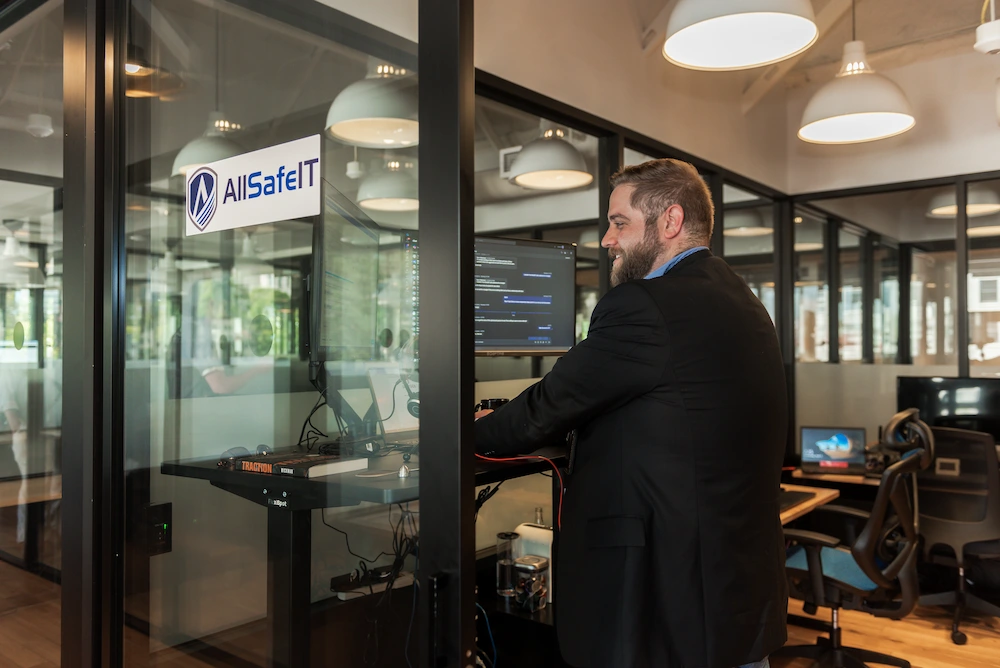
AllSafe IT provides fully managed infrastructure as a service that combines cloud computing resources with expert management and support.
We work with leading cloud service providers including Google Cloud and Microsoft Azure to deliver enterprise-grade infrastructure. These platforms provide the foundation. Our management makes them work effectively for your business.
Our approach starts with understanding your requirements. Application development needs differ from big data analysis workloads. Web apps require different infrastructure than backend processing systems. We design cloud based infrastructure matching actual use cases rather than forcing generic configurations.
Implementation happens systematically. Our expert cloud migration team moves existing applications to the cloud, while our server management protocols configure virtual machines and storage, establish networking resources, and implement security controls. Most transitions complete during planned maintenance windows without disrupting business operations.
What differentiates AllSafe IT is how we optimize cloud infrastructure after deployment. Many businesses implement IaaS but don’t continually adjust resources to match changing needs. We monitor usage patterns, identify optimization opportunities, scale resources automatically, and reduce waste from over-provisioned systems.
Our 24/7 monitoring ensures infrastructure performs reliably. We detect issues before they impact operations, respond to incidents immediately, and maintain detailed performance metrics. You gain visibility into infrastructure health without building monitoring systems.
With 20+ years of technology expertise and 97% customer satisfaction, AllSafe IT delivers managed infrastructure services that support business growth without adding complexity.
Infrastructure as a service for specific business needs
Different workloads benefit from infrastructure as a service in specific ways.
Development environments gain flexibility through IaaS. Development teams create isolated environments for testing, experiment with new technologies without affecting production, and deploy multiple versions simultaneously. When testing completes, teams discard test environments without managing physical equipment. This accelerates innovation while reducing costs.
High performance computing workloads leverage cloud computing power. Big data analytics processing vast datasets benefits from scalable computing resources. Computer grids and computer clusters handle complex calculations. Scientific computing, financial modeling, and data analysis become accessible without buying expensive specialized hardware.
Business continuity planning improves through cloud infrastructure. Disaster recovery systems replicate data across geographically distributed data centers. If primary systems fail, operations failover to backup infrastructure automatically. This protection would be cost prohibitive using on premises data centers.
Rapid scaling supports business growth and seasonal variations. Retail businesses handle holiday traffic spikes. Media companies manage campaign launches. Professional services accommodate project teams. Infrastructure scales to meet demand without lengthy procurement processes.
Application modernization happens incrementally. Organizations move legacy applications from on premise infrastructure to cloud environments in phases. This approach manages risk while gaining cloud benefits. The incremental process allows thorough testing before migrating critical systems.
Benefits of managed infrastructure as a service
Managed IaaS delivers advantages beyond basic cloud computing.
You eliminate upfront capital expenditures for infrastructure. No purchasing physical servers, storage arrays, or networking equipment. No building or expanding data centers. You convert capital expenses to predictable operational costs that scale with usage.
Infrastructure management burden shifts to specialists. You don’t hire experts in virtualization, storage, or networking. You don’t troubleshoot hardware failures or manage vendor relationships. Our team handles infrastructure management while your staff focuses on business applications.
Scalability happens on demand. Scale resources up during growth or peak periods. Scale down during quiet times to reduce costs. This flexibility prevents both under-capacity during growth and over-capacity waste during slower periods. The IaaS model supports business agility.
Security capabilities exceed typical internal implementations. Enterprise-grade controls protect infrastructure. Continuous monitoring detects threats. Automated response mitigates risks. Professional security management would be cost prohibitive for most organizations to build internally.
Business continuity strengthens through redundant infrastructure. Data replicates across multiple locations. Failover happens automatically. Disaster recovery testing validates backup systems. Your operations resist hardware failures, natural disasters, and other disruptions.
Performance optimization happens continuously. We monitor infrastructure performance, identify bottlenecks, adjust resources proactively, and ensure applications run efficiently. This ongoing optimization prevents the performance degradation common with static infrastructure.